Framework v0.1 · modules in development
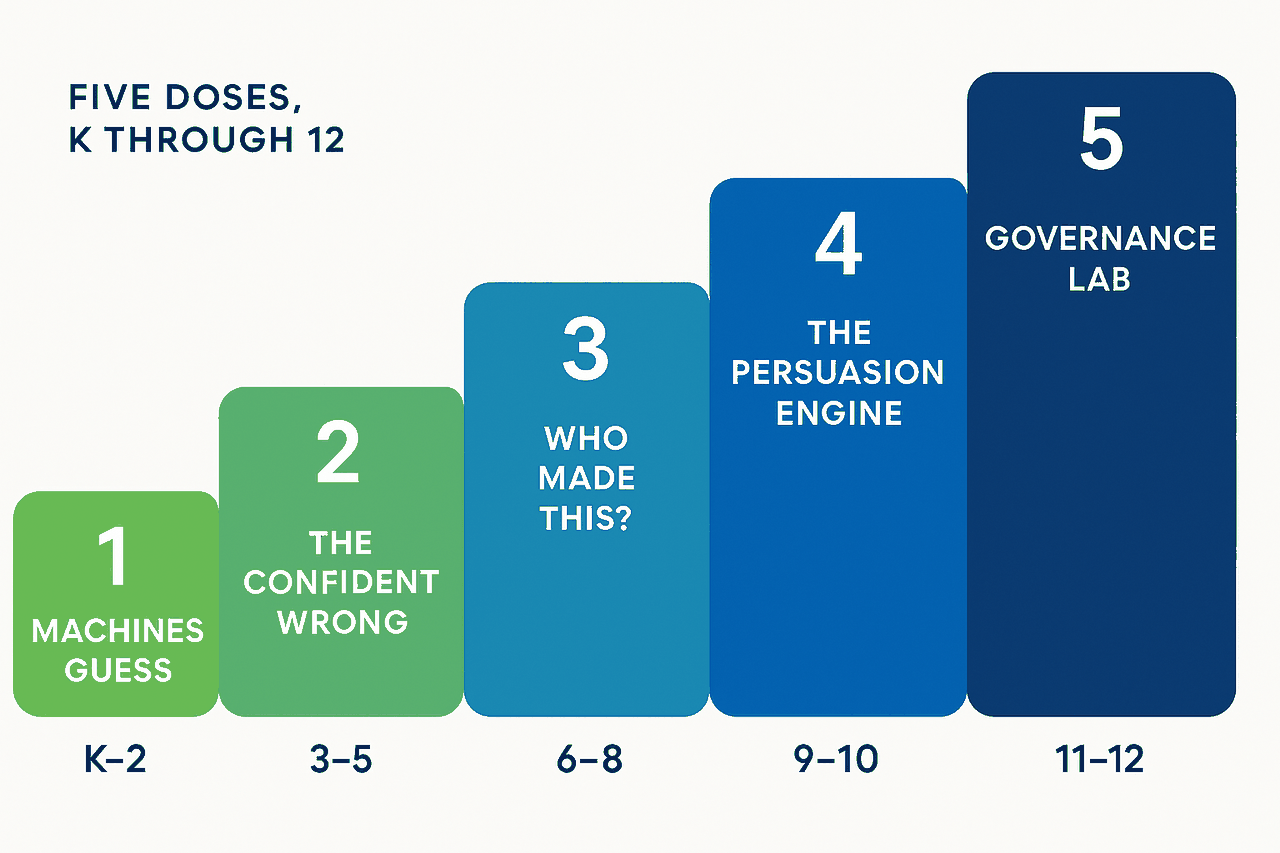
Five doses, K through 12
Free. Open-licensed. Offline-capable. No student accounts before the concept, no student data collected, ever.
Every design rule below is derived from a specific finding on the evidence page. Where the research is thin we say so, and we build the instrument to measure it.
Before the lessons
Ten design rules, and what each one comes from
| Rule | Derived from |
|---|---|
| Specimen, not servant. The machine's output is the object of study; it never does the student's work. | Bastani 17% crutch effect; Kosmyna cognitive debt |
| Hints, never answers in any tool we endorse or configure. | Bastani's tutoring arm reached parity with the textbook control |
| Weakened dose plus refutation, before the real-world encounter. | McGuire; van der Linden & Roozenbeek; Bad News d ≈ 0.37 |
| Teach the technique, not the example. | Inoculation generalises to strategies, not instances |
| Teacher on the glass through grade 5; no student accounts before the concept. | Screen-time evidence; developmental appropriateness |
| Measure transfer unassisted, never performance-with-access. | Stanford: "short-term boost, uncertain transfer" |
| Preserve productive struggle as non-negotiable; remove only extraneous load. | Sweller; "easier doesn't mean better" |
| Teach that students prefer the tools that teach them least. | Kreijkes 2026; Blasco & Charisi 2025 |
| Companion AI is studied, never used. | Common Sense: unacceptable risk under 18 |
| No child left behind by bandwidth — every dose has an unplugged path. | 15.7M Americans without broadband; the regressive-ban argument |
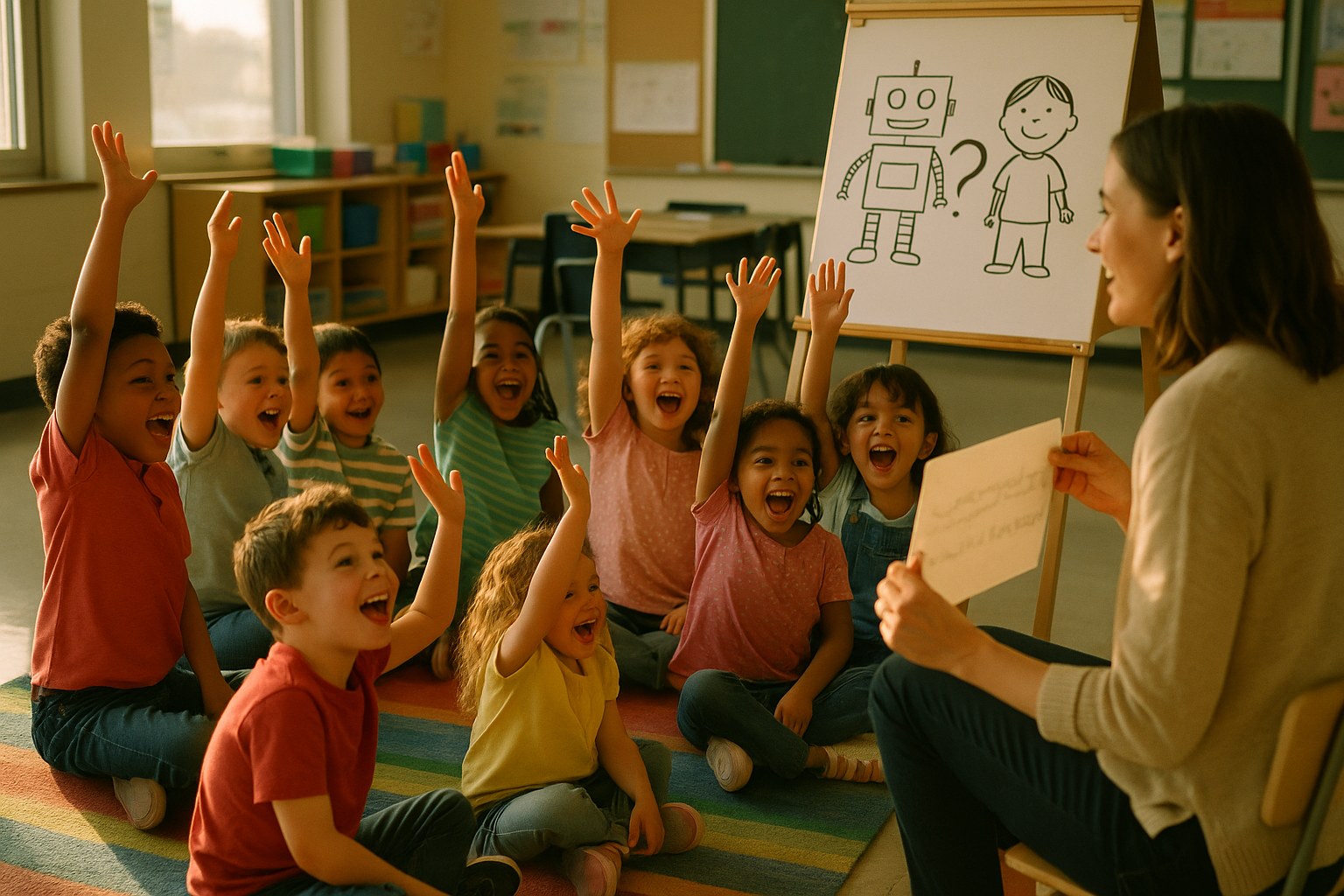
Machines Guess
Unplugged. No screens, no student accounts. 3 × 25 minutes.
A machine that guesses the next word is not a person, and it does not know things.
- The Guessing Game. The class collectively completes sentences the teacher starts. The class is the model. Students discover they can produce a confident ending without knowing whether it is true.
- Person or Machine? A sorting activity — who has feelings, who remembers you, who can be your friend. This establishes the boundary that companion chatbots are engineered to blur.
- The Grown-Up Rule. If a machine asks you something about yourself, tell a grown-up.
Assessment: oral. Can the child explain, in their own words, that the machine is guessing?
The Confident Wrong
Teacher-projected, whole class. No student accounts. 4 × 40 minutes.
Being sure and being right are different things — for machines and for people.
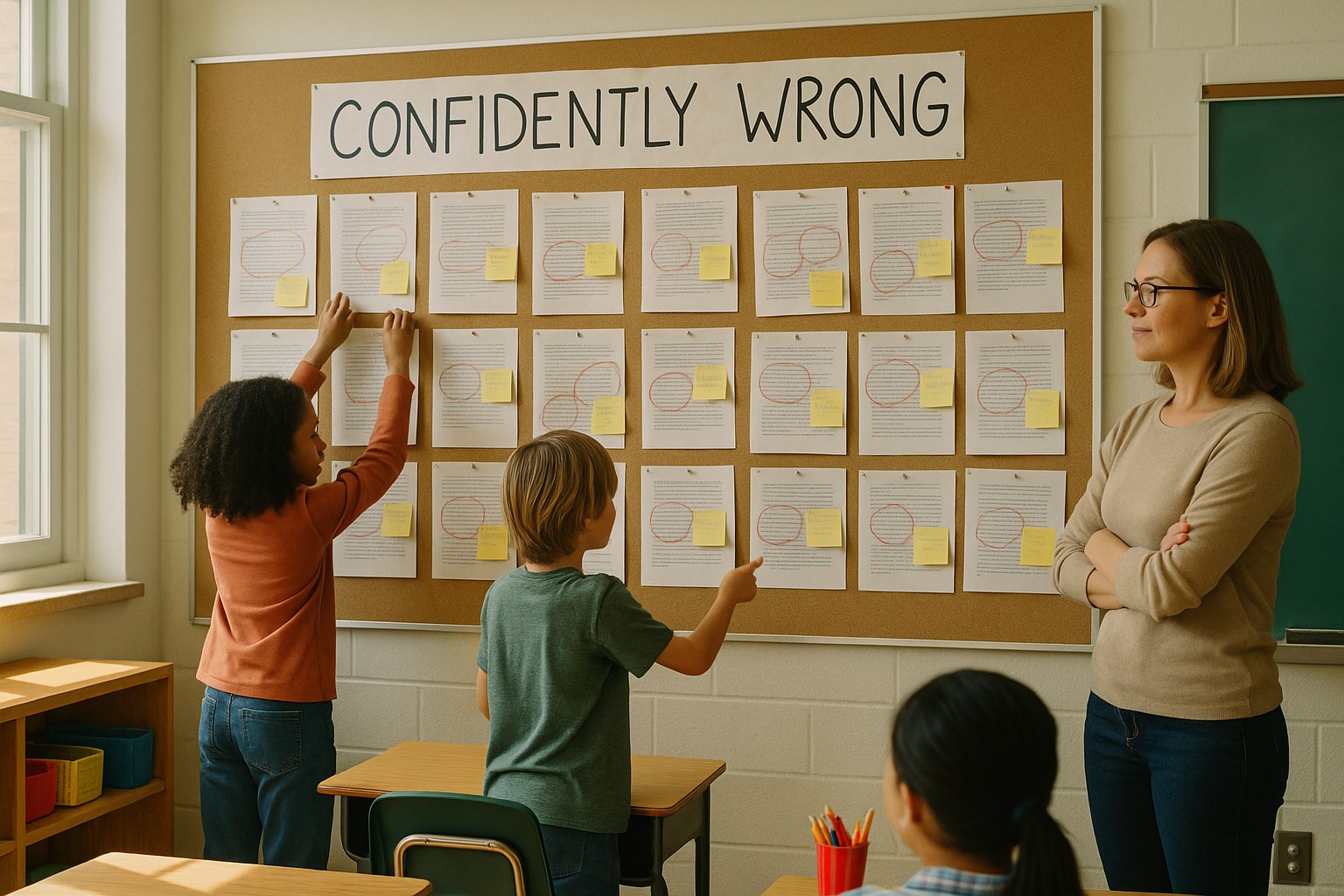
- Hallucination Hunt. The teacher queries a model on the class's own subject matter. Students score the outputs and catch fluent, confident errors. A running Confident Wrong wall accumulates specimens through the year.
- The Check-It Reflex. Three-source verification and lateral reading, drilled to automaticity — the technique that carries the largest measured effect sizes in the media literacy meta-analysis.
- Where Did It Learn That? Age-appropriate introduction to training data, and to bias as an inherited property rather than a malfunction.
- Ask It Twice. Students see the same prompt produce different answers, and reason about what that means.
Assessment: unassisted. Given three claims, identify which requires verification and describe how to verify it.
Who Made This?
Supervised lab, teacher-managed accounts. 6 × 45 minutes.
Anything can be fabricated. Your job is to ask who made it, why, and how you would check.
This dose is delivered in the grade band where peer image abuse begins — and it is precisely the band a K–8 moratorium removes from reach. 1.2 million children reported being depicted in sexual deepfakes in a single year; 94% of identified school victims were girls.
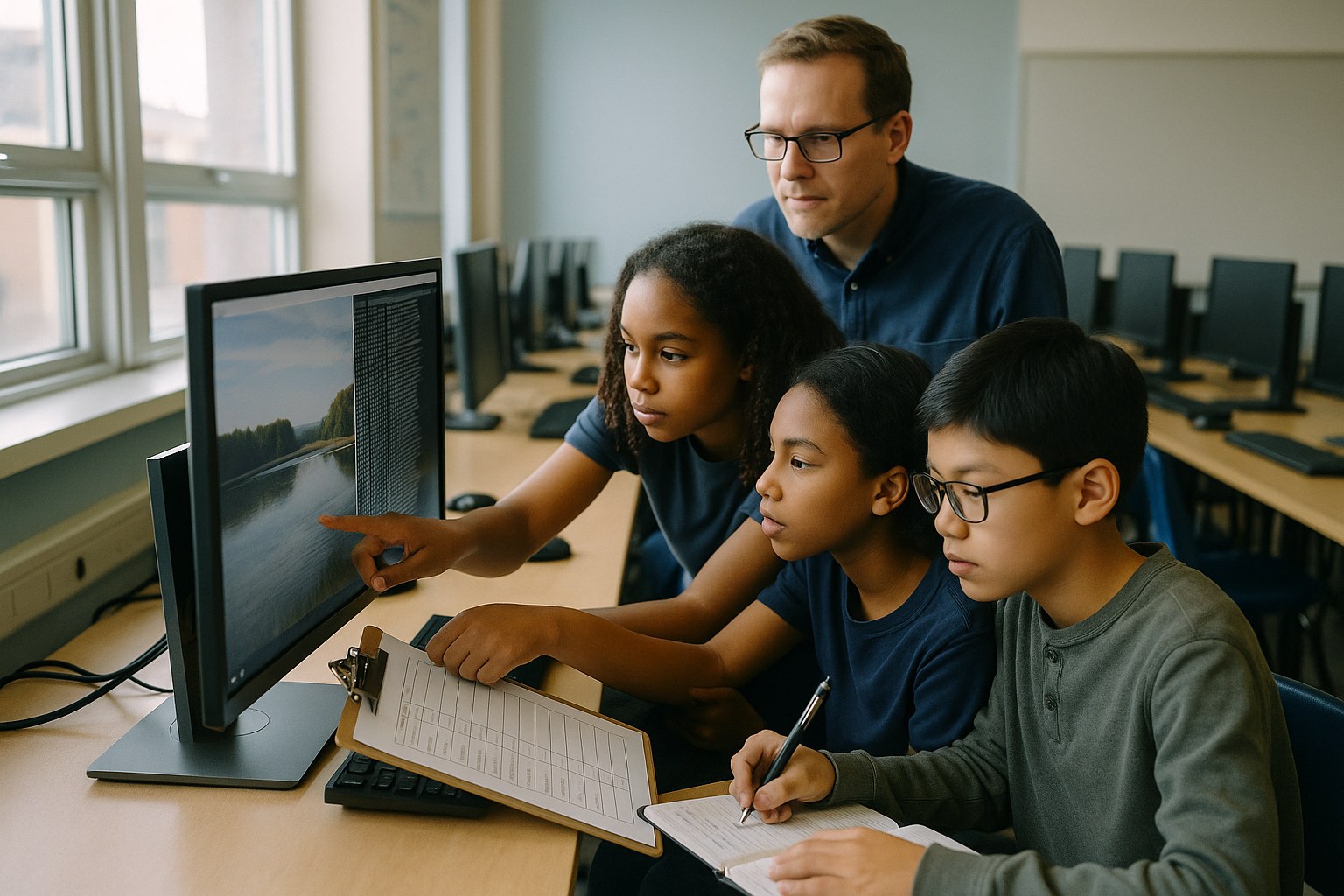
- Provenance and Forensics. Content credentials, metadata, reverse image search, cross-referencing — hands-on detection practice on prepared synthetic media.
- Synthetic Media and Consent. What it costs a person to be depicted without their agreement, taught with the Pennsylvania case as a documented, discussable event.
- If It Happens To You Or A Friend. A concrete protocol: preserve evidence, do not forward, report to a named adult, know the reporting channels and the law in your state. Students leave with a card.
- The Voice On The Phone. Voice cloning, grandparent scams, and family code words.
- Why It Feels Like A Friend. Engagement optimisation, sycophancy, and the design choicesbehind companion chatbots — studied, never used.
Assessment: unassisted. Given a media artifact, produce a provenance assessment with reasoning.
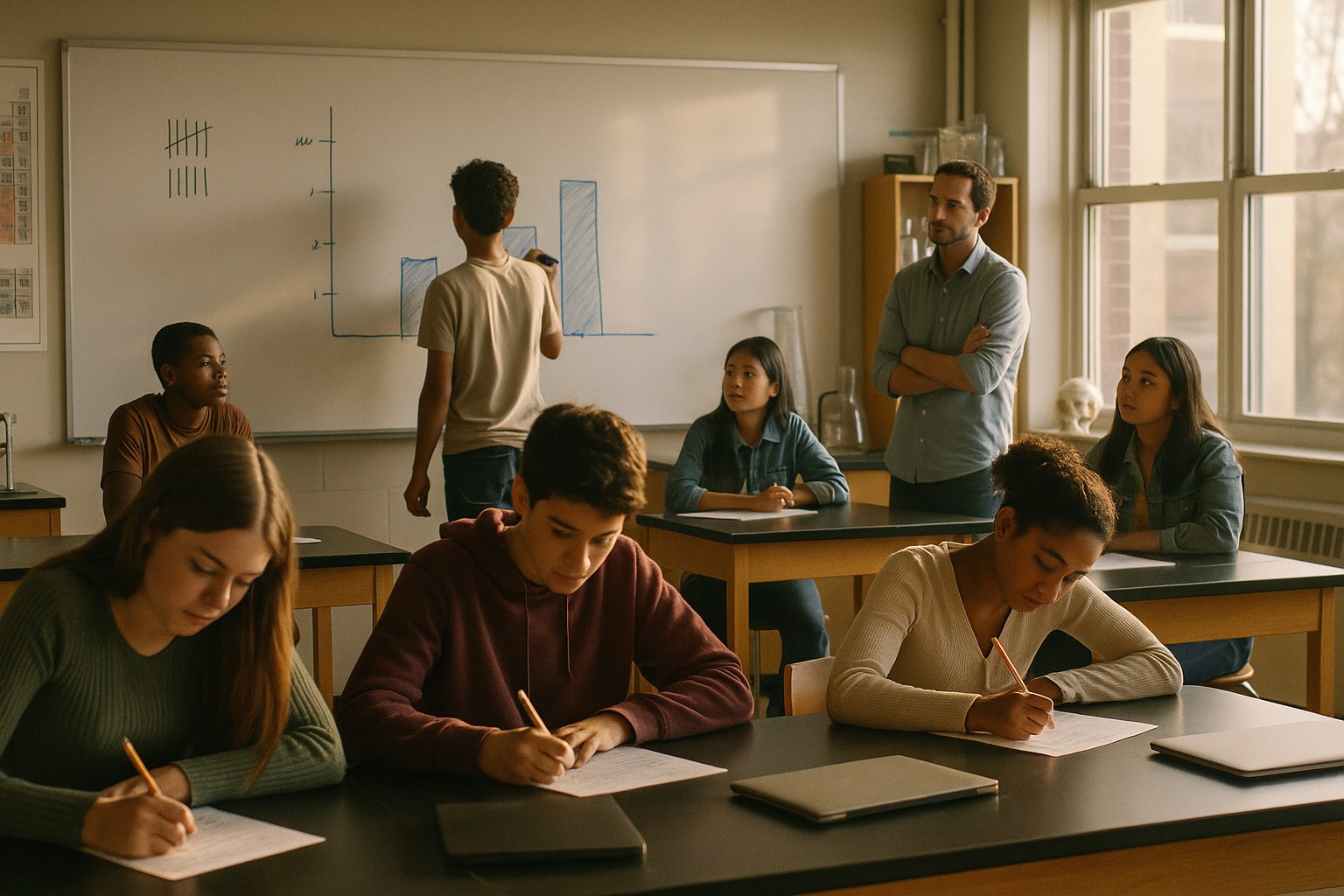
The Persuasion Engine
Lab with sandboxed tooling. 8 × 50 minutes.
You resist manipulation by learning to perform it, weakly, under supervision.
- Build a Weak Manipulator. In an isolated sandbox, students construct a system prompt designed to flatter, to hedge, to fabricate a citation, to shift a frame. Learning the moves from the inside is what confers technique-general resistance — the direct application of the Bad News model to generative AI.
- The Cognitive Debt Lab. Students replicate the MIT finding on themselves: write with an assistant, then attempt to quote their own paragraph from memory. Class-level data is collected and compared to the published 83% / 11% split.
- The Guardrail Experiment. Two arms — unrestricted assistant versus hints-only tutor — then an unassisted assessment. Students recover the Bastani result with their own data.
- The Preference Trap. Students rate helpfulness before seeing outcome data, then confront the gap.
- Bias Audit. Structured probing for disparate outputs across names, dialects and contexts.
Assessment: unassisted analytical essay plus a lab notebook of self-collected data.
Governance Lab
Project-based, semester or intensive. Culminates in public work.
These systems will be governed by people. You are those people.
- Red Team. Structured adversarial testing of a permitted model against a rubric, producing a written vulnerability report.
- Model Audit. Fairness, accuracy and failure-mode assessment against a documented standard.
- Impact Assessment. Evaluate a real proposed deployment — in a hospital, a court, a hiring pipeline, a school — and write the assessment.
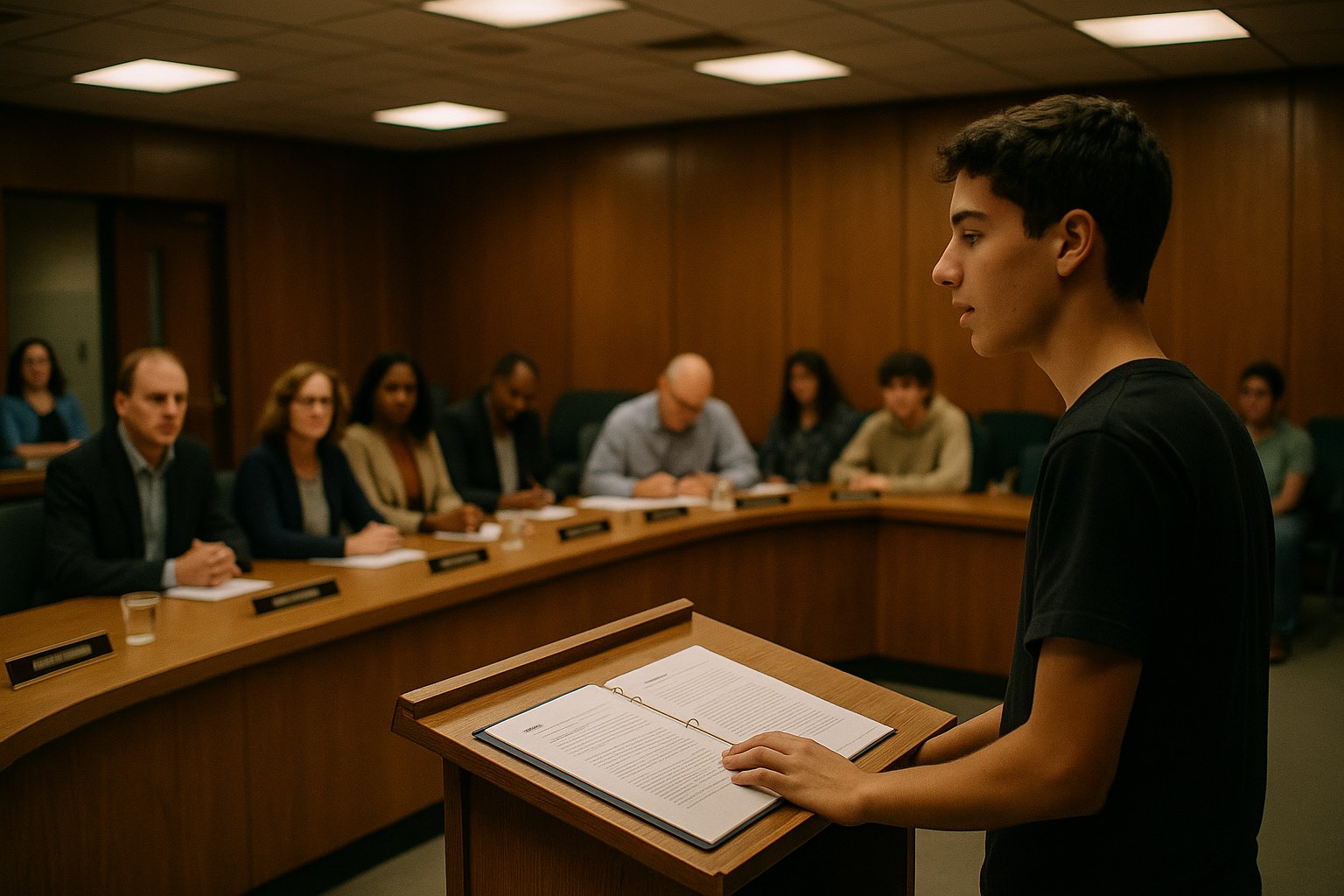
- Draft The Policy. Students write an AI acceptable-use policy for their own school, reconcile competing stakeholder interests, and defend it before a real school board.
- Resistance and Refusal. Case studies in whistleblowing, conscientious objection in engineering, regulatory capture, and the practical mechanics of saying no.
Assessment: public defence. Artifacts are real and are submitted to real bodies.
Support programme
Educator Corps
Teacher preparation is the binding constraint, so it ships first — aligned to the UNESCO AI Competency Framework for Teachers, and informed by Stanford's finding that AI pedagogical support is most effective for less experienced instructors.
- A 12-hour foundation — how these systems work, how they fail, how they persuade.
- Dose-specific facilitation guides with anticipated student questions and misconceptions.
- A vetted specimen library — pre-collected model failures, safe to project, no live queries required.
- An offline kit for every dose.
NYC's own policy preserves teacher AI use for planning while removing it from students. A district that trusts teachers to use AI, but not to teach about it, has identified the capability gap and then declined to close it. That gap is what the Educator Corps exists to close.

Support programme
Family Booster
72% of teens have used an AI companion. Only 37% of parents know their child uses AI at all.
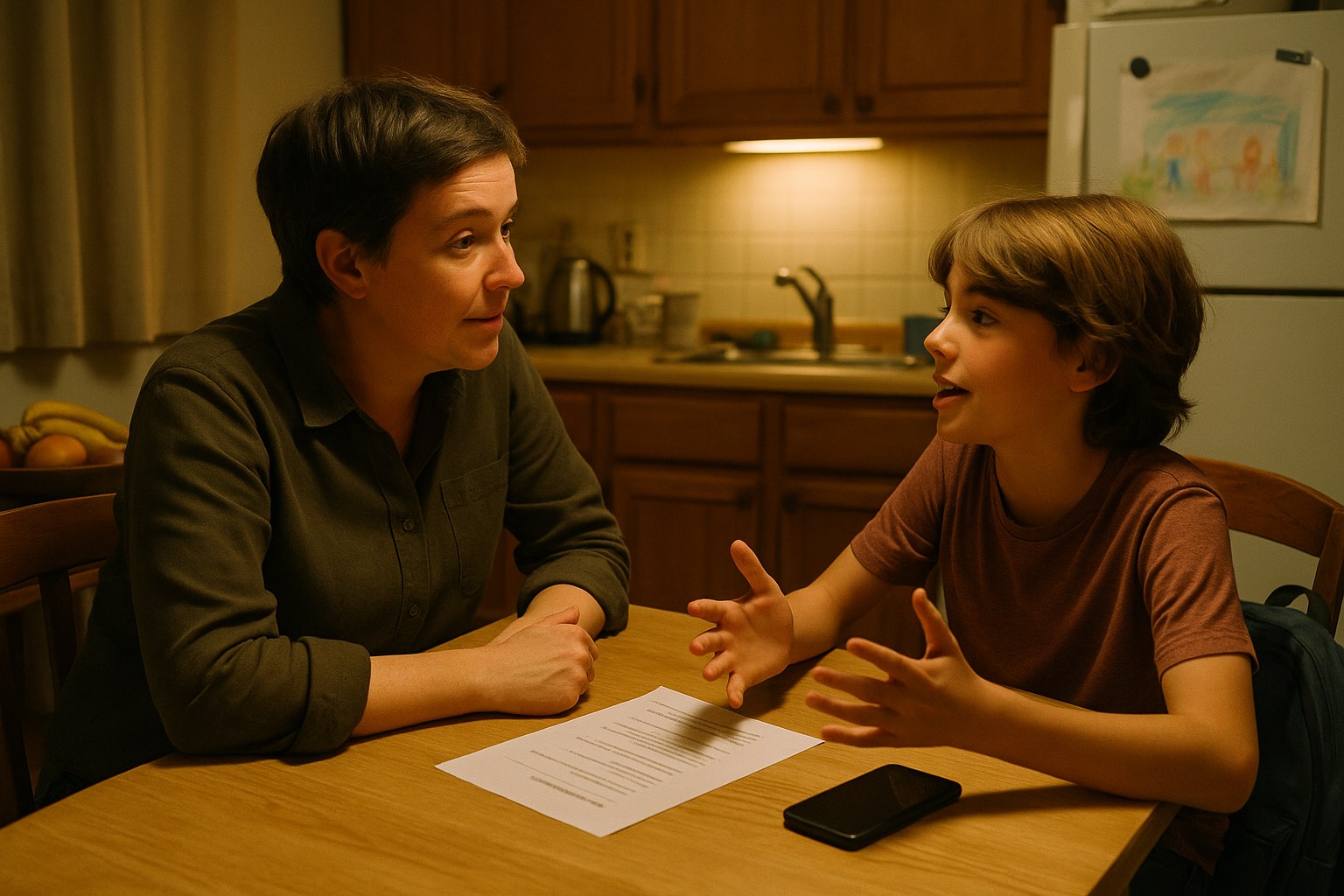
The exposure happens at home. Instruction that stops at the school gate inherits the same flaw as the ban it argues against.
- A one-page conversation guide per dose, in the languages the district serves.
- A family code word protocol for voice-cloning scams.
- What to do if your child is depicted in synthetic media — the same protocol their child receives in Dose 3, so the household has one shared plan.
The commitment that makes this different
We will report if this does not work.
The evidence base for AI literacy has no longitudinal outcome data and no high-quality causal U.S. K-12 studies. We intend to help close that gap rather than add to the pile of unmeasured programmes.
- Every dose ships with a pre/post instrument measuring unassisted transfer — never performance-with-access.
- Partner districts commit to randomized or staggered rollout where feasible.
- Instruments, anonymized data, and null results are published. Especially null results.
Curriculum and instructional materials: CC BY-SA 4.0. Code: MIT. Free forever, for any school, anywhere, with no vendor lock and no student data collection.